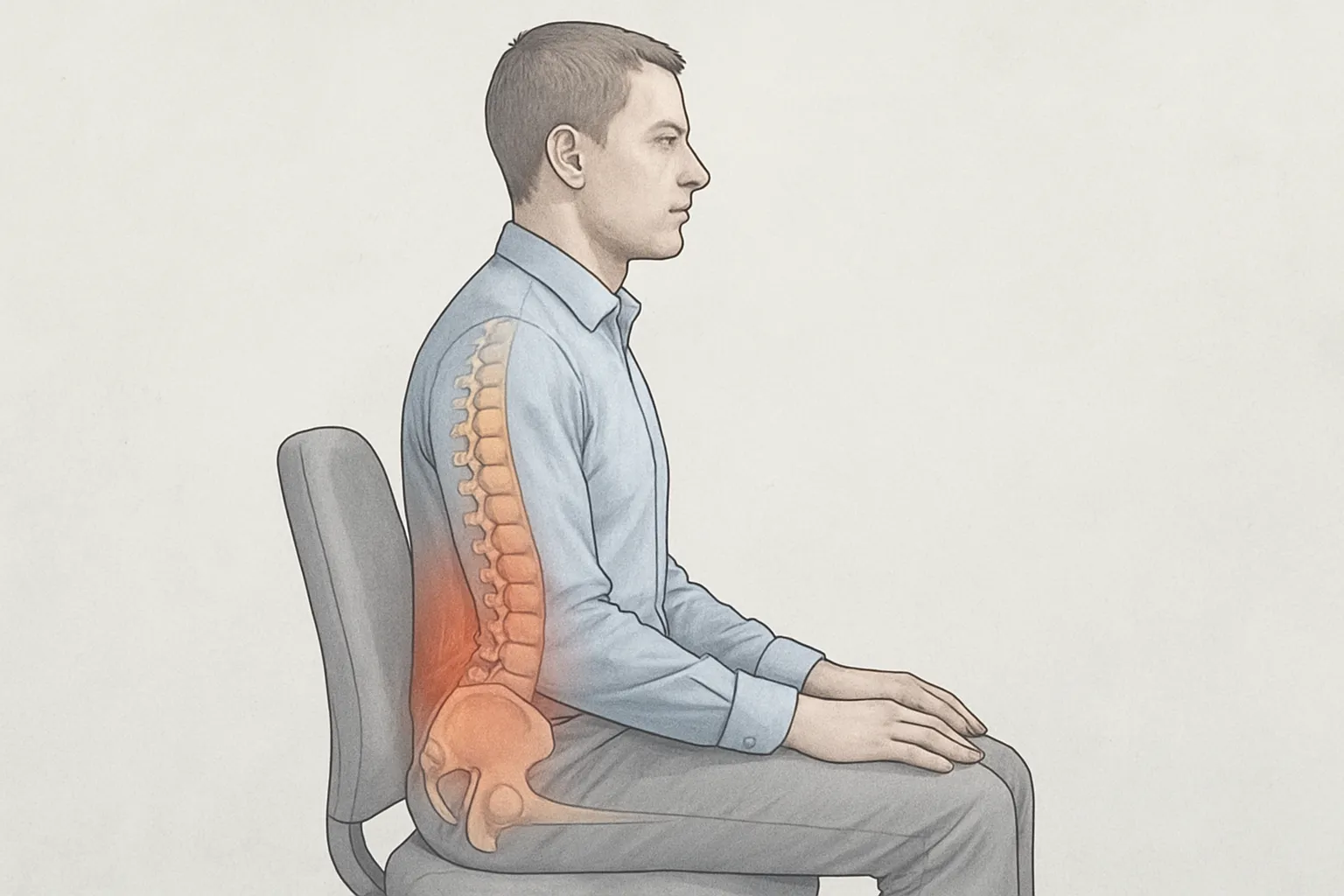
Physical activity and long-term spinal health: how movement influences the spine over the years
Regular movement exposes the spine to mechanical loads variables that stimulate the adaptation of bone, muscles, ligaments and ligaments. intervertebral discs. As the years go by, processes such as reduced disc hydration and the sarcopenia can influence load tolerance and mobility. A sustained and measured physical practice is associated with better function, greater capacity for daily activities and less stiffness, without guaranteeing the prevention of discomfort. The variability of gestures and postures favours tissue homeostasis and can modulate risk factors related to spinal pain.
For reasonable maintenance of spinal health throughout life, it is often useful to combine complementary types of exercise:
- Force of the trunk and limbs with gradual progression, prioritising technique and breath control.
- Activity aerobics moderate (e.g. walking at a good pace), adaptable to the level and possible sensitivities.
- Mobility and flexibility of hips, thoracic spine and ankles, with comfortable ranges and without forcing pain.
- Balance and coordination to fine-tune proprioception and stability in everyday tasks.
Dosage is more important than the “perfection” of the exercise: alternating intensities, respecting breaks and adjusting volume help to manage the accumulated load. Signs such as pain that progresses and does not subside with rest, loss of strength, marked irradiation or changes in sensation suggest assessing the situation with a professional. In people with specific conditions (e.g., osteoporosis or stenosis), customisation of the type and range of motion is key to maintain the motor control and function without overexerting tissues. Reducing prolonged periods of sedentary lifestyles through active breaks and postural variation can prudently complement structured exercise.
Strength, mobility and aerobic exercises to support long-term spinal health without overloading the spine
Strength: endurance and control without overload
The aim is to develop resistance and control of the muscles that stabilise the spine (especially the gluteus, deep abdominals and dorsal muscles) with gradual progression and emphasis on neutral technique of the spine. Prioritise comfortable ranges, moderate sets and sufficient rest. If acute, radiating pain or loss of strength occurs, stop and adjust the load or form with qualified help.
- Hip hinge with stick (to learn lumbopelvic alignment).
- Gluteal bridge and variations (single and double leg, depending on tolerance).
- Rowing with elastic band or light dumbbell, focusing on shoulder blades.
- Assisted split squat or short stride, controlling the pelvis.
- Bird-dog (alternate arm-leg extension) and modified side plank for core.
Mobility: hip and thoracic spine as allies
Mobility directed at the hips and thoracic region can reduce unnecessary loads on the lower back. It uses gentle, non-bouncing movements within the individual tolerance, breathing in a controlled manner and avoiding positions that provoke symptoms.
- “Soft cat-camel for segmental mobility without loading.
- Thoracic rotations in quadruped or lateral decubitus.
- Hip flexor stretch with neutral pelvis.
- Hamstrings at 90/90 or with a band, without forcing the range.
Aerobic activity: consistency and low impact
The aerobic activity of low impact and the sensation of moderate effort can promote circulation and the ability to exert effort without subjecting the spine to sudden loads. Increase the time gradually and prioritise regularity over intensity.
- Walking on a stable surface, exercise bike, elliptical trainer or aquatic exercise.
- Maintain a pace that allows for normal conversation.
- Progress in duration and frequency first; intensity is adjusted later.
- If discomfort increases or persists the next day, reduce load or choose another modality.
Precautions, adaptations and warning signs before starting exercise if back pain is present
Precautions and initial adaptations
- Prioritise gradual progression: start with low volumes and low loads, increasing gradually according to tolerance, without pursuing “pain at all costs”.
- Opt for smooth isometries, mobility within a comfortable range, and exercises of lumbopelvic stabilisation; avoid peak loads, impacts and repeated flexion or extension movements that reproduce symptoms.
- Caring for the techniqueThe spine in neutral position when possible, respiratory control (avoid Valsalva manoeuvre), stable support and slow transitions.
- Modify variables if discomfort appears: reduce amplitude, pace or series; divide the session into short blocks with breaks.
Symptom monitoring
- Use a subjective 0-10 scale as a guideline: mild and transitory discomfort is usually acceptable; the growing pain during the session or that clearly persists the next day suggests adjusting the load.
- Discontinue the exercise before sharp stabbing pain, irradiation that is accompanied by tingling, numbness, or weakness, or if dizziness or general malaise occurs.
- Distinguish between muscle tenderness post-exertion and neuropathic pain (burning, electric cramp, strength failure); record which gestures provoke it to guide adaptations.
Red flags
- Progressive neurological deficitsmarked weakness, foot drop, loss of sphincter control, saddle“ anaesthesia”.
- Fever, chills, chills, back pain with recent infection or immunosuppression.
- Unexplained weight loss, a history of cancer or persistent nocturnal pain that does not subside with rest.
- Trauma recent (even mild if osteoporosis or long-term corticosteroid use is present) or pain after minimal exertion in the elderly.
- Oppressive chest pain or associated systemic symptoms (general malaise, profuse sweating, dizziness).
Sedentary work and the spine: active breaks and safe movement patterns during the working day
In sedentary work it is advisable to introduce frequent short breaks to break prolonged immobility. A practical guideline is to get up 1-2 minutes every 30-45 minutes to walk a few steps and change posture. The postural variability (alternating sitting/standing if possible, adjusting backrest and footrest, rearranging keyboard and screen position within tolerance) is usually better tolerated than maintaining a single posture for hours at a time.
Safe active breaks: practical ideas
- Gentle walking 1-2 minutes, with relaxed arm swinging.
- Cervical mobility: slow tilts and turns in the cervical region comfortable range, without bouncing or pain.
- Shoulder circles and gentle scapular retraction to activate the upper back.
- Seated chest extension: open the chest by resting the hands on the backrest and breathing calmly.
- Hip hinge and mini squats to the chair, maintaining control and not blocking breathing.
- Ankle rolls and heel/toe lifts to promote venous return and general movement.
In order to maintain the low intensity movement During the day, prioritise controlled technique, calm breathing and the absence of sharp pain. Start with 5-8 repetitions per exercise or 20-40 seconds and adjust according to tolerance, applying a gradual progression (more repetitions or longer only if well tolerated). Discontinue or modify the activity if progressive increase in pain, irradiation, tingling, unsteadiness, dizziness or blurred vision occurs. Keeping active breaks consistent throughout the day is often more helpful than concentrating them at a single point in time.
What the scientific evidence suggests about exercise and long-term prevention of low back pain
Scientific evidence suggests that maintaining a regular exercise programme is associated with a reduced risk of low back pain onset and recurrence in the medium to long term. The effect size is usually modest and varies between individuals; the overall certainty is low to moderate due to the heterogeneity of trials and to differences in populations, types of exercise and follow-up. No clearly superior method has been identified; approaches combining strength, motor control and aerobic capacity show more consistent signals. The education combined with exercise can provide additional benefits over exercise alone.
In practical terms, the best-supported programmes share a number of characteristics:
- Trunk and hip strength work with tolerable loads and careful technique.
- Motor control and lumbopelvic stability exercises to improve the movement pattern.
- Low to moderate intensity aerobic activity according to physical condition.
- Mobility and flexibility as a complement according to tolerance and functional demands.
- Gradual progression of volume and intensity, avoiding sudden peaks of load and respecting recovery.
- Symptom monitoring to adjust the plan if persistent increases in pain occur.
The adhesion The sustained activity seems to be more determinant than the exact type of exercise; integrating the activity into the routine and adapting it to preferences and context favours continuity. After a previous episode, maintaining physical activity and reintroducing strengthening progressively is associated with a lower probability of recurrences, without guaranteeing them. Individualisation is key in the presence of comorbidities or specific limitations, and cases with acute disabling pain or alarm signs require clinical assessment.