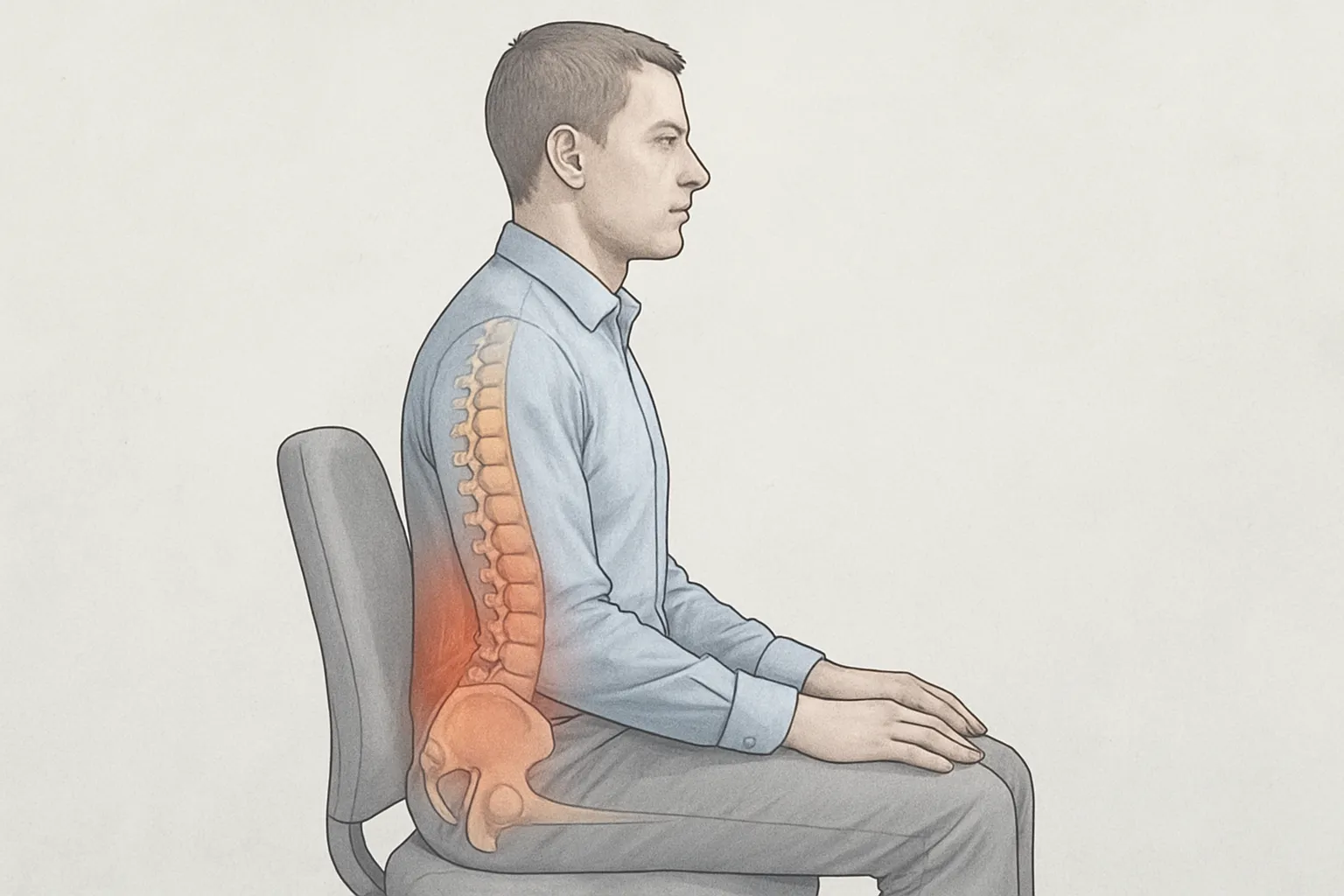
Prolonged sitting posture and lumbar loading: clinical definition and distribution of forces in the lumbar spine
Operational clinical definition
In clinical practice, the prolonged sitting posture is described as sitting for extended periods of time with little postural variation and low trunk muscle activation. This scenario is of interest because it conditions sustained mechanical loading on the lumbar spine, especially when combined with pelvic retroversion and reduction of the pelvic girdle lumbar lordosis, The stress distribution between passive and active structures is modified by these situations.
Distribution of forces in the lumbar spine
In the seated position, the trunk weight vector and pelvic orientation influence how loads are distributed along the lumbosacral segment. Broadly speaking:
- Compressive load predominant on vertebral bodies and intervertebral discs, which tends to concentrate in the anterior compartment when the spine is flexed and lordosis is reduced.
- Shear forces anterior at L4-L5 and L5-S1, favoured by sacral tilt and forward displacement of the trunk; may increase if the seat allows pelvic sliding or if working at an incline.
- Flexion moment requiring sustained activity of the extensor musculature; with fatigue, some of the load is transferred to discs, ligaments and facet capsules.
- Variation of intradiscal pressure according to trunk angle and backrest support: greater heterogeneity in maintained flexion; dorsal/thoracic support redistributes the load vector towards the backrest and reduces the moment on the lumbar spine.
Relevant modulating factors
Elements such as seat height and depth, hip-knee angle, use of lumbar support, surface firmness and trunk position (upright, inclined, reclined) significantly modify the distribution of forces. Pelvic and sacral morphology, motor control capacity and extensor fatigue also influence how much falls on passive versus active structures. Postural changes over time, even of small magnitude, temporarily alter the loading pattern without necessarily implying uniform clinical effects for all individuals.
Personal and work environment risk factors influencing low back load during prolonged sitting
Personal factors
- Previous history of low back pain or recurrent episodes: associated with increased sensitivity to static loads and decreased tolerance to sustained sitting.
- Physical fitness and trunk and gluteal endurancereduced support capacity may promote passive flexion and increase the demand on discs, ligaments and facet joints.
- High BMI and abdominal distributionincrease the flexor moment on the spine at rest, favouring sustained lumbar kyphosis.
- Limited hip and hamstring mobility: promotes pelvic retroversion and lumbar flexion alignment during seated posture.
- Smoking and metabolic comorbidities: these have been associated with poorer disc nutrition and reduced tissue resilience to repeated loading.
- Psychosocial stress and fatiguemay increase muscle co-contraction and the perception of discomfort in prolonged static postures.
Work environment factors
- Poorly adjustable posts (chair, armrests, footrests): make it difficult to align hips and knees and maintain sufficient lumbar support.
- Inadequate seat and desk height: they force you to stoop or raise your shoulders, increasing sustained lumbar flexion and compressive loading.
- Screen, keyboard and mouse layout far or off-centre: induces continuous cervical protraction and thoracolumbar kyphosis, with greater demand on lumbar structures.
- Hard-edged surfaces and insufficient legroom
- Absence of scheduled breaks and high cognitive load: they favour immobility and permanence in the same alignment.
- Whole body vibration (e.g. prolonged driving): has been associated with increased mechanical load on the lumbar region.
- Cold thermal conditions or draughts: may increase muscle stiffness and discomfort when sitting.
increase contact pressure and limit postural variability.
Relevant interactions
The combination of lower trunk strength, limited hip mobility and a poorly adjustable stance favours sustained flexion alignments, associated with greater ligament and compressive demands. In people with previous history of low back pain o High BMI, In addition, the same conditions can amplify the perceived burden. Organisational factors (pacing, availability of breaks) and psychosocial stress modulate muscle tone and postural variability, influencing tolerance to prolonged sitting.
Symptoms related to prolonged sitting and low back strain, and prudent criteria for seeking medical assessment
Frequent symptoms
Prolonged sitting increases intradiscal pressure and static load on lumbar structures. Symptoms of mechanical origin may include lumbar pain dull or throbbing pain that worsens on sitting or sitting up after long periods, muscle stiffness and fatigue in the lumbar region and hips, paravertebral hypersensitivity and spasms. Discomfort referred to the buttocks or back of the thigh without frank irradiation below the knee is common. The following may also occur transient paresthesias (tingling or numbness) when holding the same position, which usually subsides when changing position or walking.
Prudent criteria for seeking medical evaluation
Clinical assessment is recommended when, in addition to the typical discomfort caused by low back pain, there are warning signs or the condition does not progress favourably.
- Severe or persistent pain that does not improve after 2-6 weeks of reasonable self-care and postural measures, or pain that significantly interferes with rest.
- Nocturnal waking pain or pain at rest with no clear relationship to movement.
- Neurological deficits: progressive weakness in one or both legs, foot drop, marked loss of sensation or reflexes.
- Data compatible with cauda equina syndrome: sphincter disorders (retention or incontinence) and saddle anaesthesia.
- Radiculopathy with below-knee irradiation and progressive deterioration of numbness, pain or tingling following a dermatomal pathway.
- Fever, chills, unexplained weight loss, history of cancer, immunosuppression, long-term use of corticosteroids or injecting drug use.
- Pain after relevant or even mild trauma in the presence of risk of bone fragility (e.g. osteoporosis).
- New or progressive structural deformity of the spine, or localised pain with marked bony tenderness.
Ergonomic adjustments and workstation configuration aimed at reducing the lumbar load during seating
Maintain a neutral alignment of the spine and a stable pelvis helps to distribute the forces on the lumbar region during seated sitting. The aim is to minimise extreme flexion or extension positions and to avoid supports that compress soft tissues. Adjustments should be individualised according to height, body proportions and personal tolerance, monitoring sensations of discomfort as a signal to re-evaluate the configuration.
- Seat heightfeet fully supported; knees at or slightly below hip level. If the table is high and raises the shoulders, consider a stable footrest.
- Lumbar supportbackrest with a soft curvature that follows the physiological lordosis; if the backrest is flat, a thin lumbar support can be useful without forcing hyperextension.
- Seat depth: leave 2-3 fingers between the edge of the seat and the popliteal fossa to avoid compression and promote pelvic mobility.
- Back angle90-110° is usually recommended; a slight recline, with the pelvis well supported, may decrease the bending moment on the spine.
- Seat surface: medium firmness and rounded front edge; avoid crossing legs continuously so as not to disturb the pelvic load.
- Table height and armrestThe armrests should allow the forearms to be approximately horizontal and the shoulders relaxed. The armrests should allow the elbows to be gently lowered without raising the shoulders or pushing the back forward.
- Screenupper edge at eye level or slightly below, at approximately arm's length, to reduce the tendency to cervical and trunk flexion.
- Keyboard and mouseClose to the body, at the same height, avoiding long reaches that induce lumbar flexion or shoulder elevation. If documents are used, place them on a lectern that is aligned to minimise repeated turning.
- Short pauses and postural variationAlternating moments of back support with more active sitting and frequent short breaks can help to modulate the accumulated mechanical load on the lower back.
Active breaks, postural variability and safe mobility to modulate low back strain during long sitting periods
Active breaks
The introduction of micro-pauses at regular intervals during the prolonged sitting aims to reduce continuous time under load and to encourage changes of stimulus. For many people, frequent short breaks (e.g. seconds to a minute at a time), adjusted to tolerance and the demands of the task, are useful. These breaks can include simple, low-impact movements that do not generate additional fatigue:
- Brief stand-ups and a few steps.
- Gentle mobilisation of the hips and thoracic spine.
- Light shoulder extension and diaphragmatic breathing.
Postural variability
There is no single “perfect” stance for all contexts; the postural variability seeks to distribute the lumbar load over time. Alternate backrest angles within comfortable ranges, make small adjustments of pelvic anteversion/retroversion, changing the footrest or changing the point of contact in the chair are reasonable strategies. The practical guide is perceived comfort, avoiding unnecessary holding positions and prioritising frequent and tolerable changes.
Safe mobility
The safe mobility aims for controlled movements, in comfortable, non-bouncing ranges, with gradual progression according to response. Examples applicable in seated position include gentle pelvic tilts, moderate thoracic extensions, slow cervical rotations and knee slides to mobilise the hips. If a gesture causes discomfort that persists after stopping or atypical symptoms, the amplitude, speed or frequency should be reduced. In the presence of specific clinical conditions, dosage and progression require individualisation.