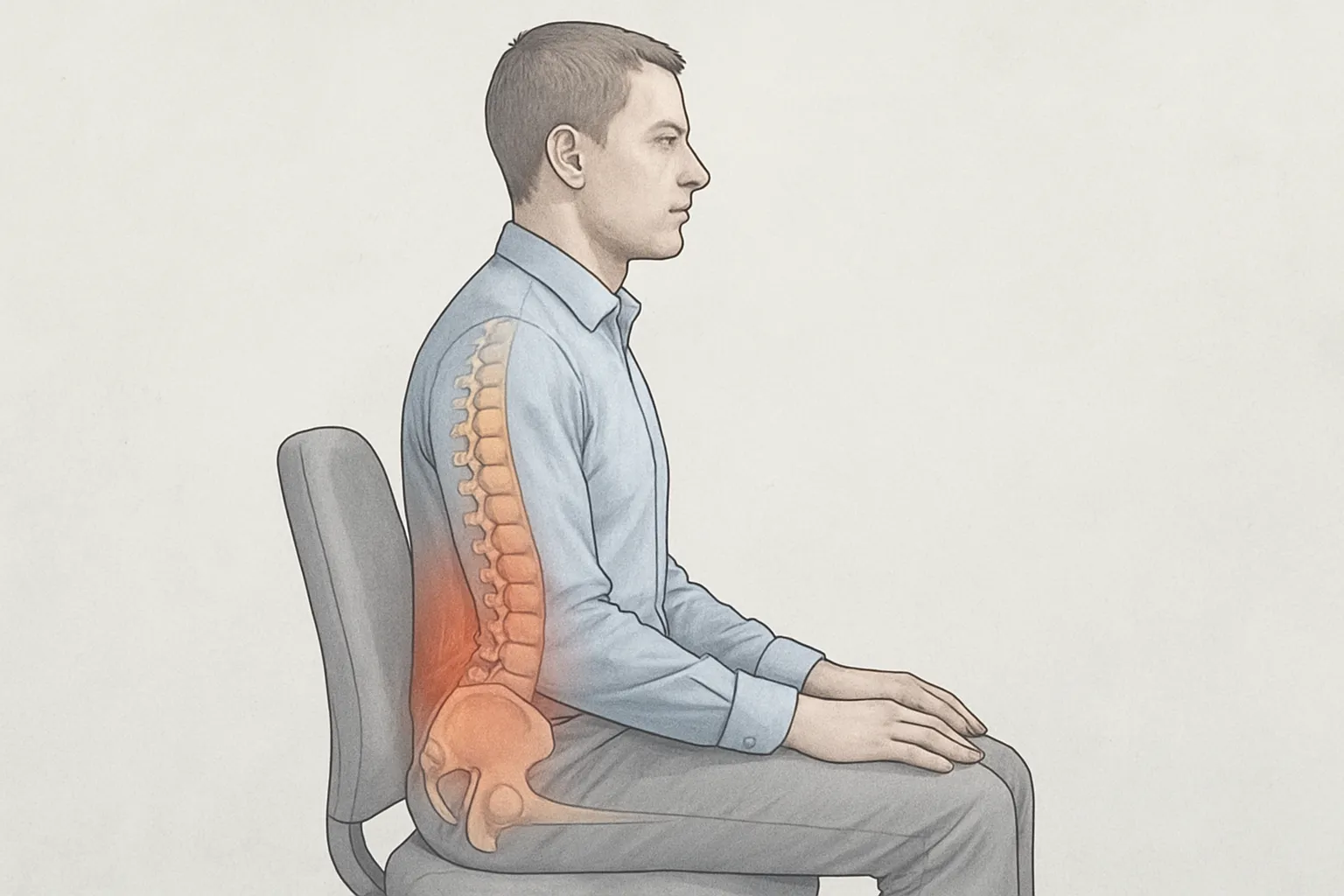
How to adapt the office workstation (chair, desk, screen and lighting) to reduce physical overload.
Chair and table
Adjusts the seat height so that your feet are fully supported and your knees and hips are at comfortable angles; if you can't reach the ground, use footrest. Keep a lumbar support that respects the natural curvature of the back and leaves a small gap between the edge of the seat and the back of the knees. The table at elbow height allow relaxed shoulders and supported forearms; try to have rounded edges or a soft support to avoid pressure on the forearms. Leave free space under the table for the legs and alternate postural changes throughout the day.
Display and peripherals
Place the centred display in front of you, with the upper edge at the eye level or slightly below, and at a comfortable distance (about an arm's length), adjusting font size and contrast so as not to overhang the trunk. Place keyboard and mouse aligned with the forearm, keeping neutral dolls and shoulders relaxed; avoid sustained deviation or extension of the wrists and use keyboard shortcuts to reduce repetitive movements. If you work with documents, use a stable document holder at the same height as the screen to minimise neck twisting.
Lighting and visual environment
Prioritise a uniform and indirect lighting and adds an adjustable task light for reading without increasing glare. Avoids reflections on the screen by positioning the workstation at an angle to windows and by adjusting curtains or diffusers; adjust the brightness and contrast of the monitor so that text is effortlessly legible. Try to use neutral-toned light and combine natural and artificial light in a gradual way. visual breaks Periodic eye movements and conscious blinking to mitigate eye fatigue, adapting these measures to your tolerance and possible pre-existing visual conditions.
Basic ergonomic job assessment: identifying risks of physical overload and when to seek professional advice
Identification of risks of physical overload
A basic ergonomic assessment focuses on detecting sources of physical overload arising from the task, tools and work organisation. Systematic observation and recording of the frequency of occurrence of risk factors helps to prioritise reasonable and safe changes.
- Sustained or forced posturesneck in flexion or rotation, trunk bent, working above the shoulders, squatting or kneeling; check if held for prolonged periods or close to joint limits.
- Force: powerful grips or grippers, lifting, pushing and pulling; assessing the distance of the load from the body and the possibility of mechanical aids.
- Repetition and rhythmShort cycles with repeated shoulder, elbow, wrist or finger movements; low task variability and insufficient breaks.
- Duration and recoveryThe following factors should be taken into account: continuous exposure time, work density and quality of breaks for muscle recovery.
- Reach and layout: objects outside the comfortable working area, working planes too high or too low, poorly positioned displays/monitors.
- Tools and contact surfaces: inadequate grips, need for additional force due to slipping, hard edges, vibration transmitted to hand-arm or whole body.
- Environmental conditionsinsufficient lighting or glare, extreme temperatures, noise that increases postural strain.
- Work organisation: time pressure, limited rotation, limited autonomy for breaks, unplanned peaks in demand.
When to seek professional advice
Basic job adjustments are not always sufficient. Specialised assessment should be sought when there are clinical indicators or risk contexts that suggest the need for further analysis and specific measures.
- Persistent symptoms or worsening: pain that does not subside with relative rest, discomfort that interrupts sleep, significant morning stiffness.
- Neurological deficitstingling, numbness, loss of strength, clumsiness or falling objects.
- Functional limitationDifficulty in performing essential job tasks or need for postural compensations in order to “be able to cope with the task”.
- History that increases vulnerability: previous musculoskeletal injuries, pregnancy, pathologies that affect joints, nerves or circulation.
- High physical demandThe following factors can be considered: regular handling of heavy loads, high repetitiveness, overhead work, prolonged awkward postures or significant exposure to vibration.
- Recent changes in processes, tools or pace of work that have coincided with the onset of discomfort.
- No improvement after reasonable basic measures (e.g. height adjustment, reorganisation of reach, structured short breaks).
- Legal or occupational health requirements requiring measurements, specific tests or individual adaptation of the job.
Work organisation to reduce physical overload: active breaks, task rotation and postural alternation.
Planned active breaks
The active breaks seek to interrupt static loading and prolonged repetition to promote tissue recovery and movement variability. Cautiously, the following can be programmed micro-pauses at regular intervals, adjusting the frequency according to the demand of the post and the individual tolerance. In these breaks, priority is given to soft mobility and controlled breathing of the neck, shoulders, spine, hips and wrists, together with diaphragmatic breathing; high-intensity manoeuvres and bouncing are not recommended. If alarm signals If the patient experiences severe pain, dizziness, persistent tingling or loss of strength, the exercises are stopped and occupational health is informed for assessment.
Rotation of tasks
The task rotation aims to distribute the load variability throughout the day to avoid sustained peaks on the same muscle groups or joints. It is useful to alternate activities that differ in biomechanical requirements (strength vs. precision, standing vs. sitting, pushing/pulling vs. fingering), respecting learning times and safety conditions. It is advisable to plan sequences that include recovery windows after demanding tasks and avoid concatenating similar efforts without an interval. The monitoring of cumulative exposure (times, repetitions, weights handled) and of reported symptoms allows the rotation to be adjusted progressively and more safely.
Postural alternation
The postural alternation consists of interspersed sitting, standing and brief movements to reduce prolonged immobility and prolonged tissue compression. Priority is given to ergonomic adjustments basic (table and seat height, footrests, location of materials within reach) and periodic changes of support, avoiding maintaining the same posture for long periods; as a general guide, introducing regular variations according to the task and tolerance is usually preferable to remaining fixed. Transitional movements are made gradually, without forcing ranges; if there is pain that does not subside with rest or neurological symptoms, the activity is stopped and professional assessment is sought. These measures must be integrated with the prevention regulations in force and the reality of each job.
Ergonomic aids and tools for manual tasks: selection criteria for reducing physical strain
The choice of technical aids y ergonomic tools should be based on a structured assessment of the task and the user. Analyse the biomechanical demand actual: magnitude and type of load (static/dynamic), frequency y duration of cycles, amplitude of outreach, need for accuracy fine, type of grip (gripper, power, two-handed), use of gloves, and wrist, shoulder and spine postures. Also consider the anthropometry, The aim is to select solutions that help to reduce peak forces, force availability, experience and possible health limitations of personnel. The aim is to select solutions that help to reduce peak forces, forceful postures, repetition and exposure to vibration, without compromising the control and safety of the process.
In hand tools and assistive devices, prioritise features that facilitate neutral postures and reduce unnecessary strain:
- Handles with suitable diameter and cross-section, non-slip glove-friendly texture and angles to promote grip neutral wrist.
- Weight content and centre of gravity close to the hand; reduction of the activation force on triggers or push buttons.
- Mechanical transmissions (lever, ratchet) and control of par/speed on power tools; noise and vibration levels attenuated.
- Lengths and heights adjustable; restraint systems or supports to avoid holding grips; trolleys, rollers and low-friction surfaces for movement.
- For load handling: ergonomic handles, lifts, adjustable tables, hoists and slings suitable for the load and the gripping point. Passive or active exoskeletons only after specific assessment and supervision.
Secure the adaptation to the environment (available space, type of surface, temperature, humidity, cleanliness, compatibility with PPE and possible sensitive atmospheres), resistance and ease of sanitisation and maintenance. Before widespread implementation, conduct pilot tests with individual fitting, training in safe use and verification of the working method. Monitoring should be based on observable and self-referenced indicators (e.g. perceived exertion, cycle times, incidents, musculoskeletal discomfort), together with regular inspections and preventive maintenance. Where possible, support decisions with applicable regulations and validated ergonomic assessment methods, documenting the criteria used.
Job accommodations for musculoskeletal pain, pregnancy or other conditions: precautions and limits
General principles
The adaptations of the post must be based on a individual assessment of the condition (musculoskeletal pain, pregnancy or other) and the actual demands of the task. Adjustments aim to reduce physical demand without totally eliminating useful activity, with progressivity y tracking periodically to adjust what does not work or generates symptoms. It is prudent to prioritise concrete, documented and temporary measures, assessing their impact on safety and the workload of the team.
Ergonomics and work organisation
- Adjustment of table and seat heights, lumbar support, footrests and positioning of screen at eye level; keyboard and mouse layout limiting wrist and shoulder deviation.
- Alternating sitting, standing and small movements; use of adjustable stations where feasible.
- Scheduled breaks and micro-breaks for repetitive or static tasks; task rotation to vary muscle groups and cognitive demands.
- Modulation of the pace of work and objectives when time demands increase the risk of overload.
Handling of loads and movements
- Define load limits per unit and per frequency; fractionate weights and use mechanical aids or assisted transport where possible.
- Plan routes and passing zones; prefer pushing to pulling when safer; avoid sharp turns and prolonged work above the shoulders.
- Reduce sustained spinal flexion/extension postures and forced grips; include regular postural transitions.
- Limit exposure to vibration (whole body or hand-arm) and high frequency repetitive movements.
Sustained increased pain, tingling or loss of strength, dizziness, or any symptom that interferes with task or safety are considered warning signs that require reassessment of the job.
Pregnancy and specific exposures
- Reduce prolonged standing and efforts involving Valsalva manoeuvres or heavy loads; facilitate postural changes, scheduled breaks, hydration and frequent access to toilets.
- Review and, if appropriate, limit exposures to chemical, biological agents and radiation, as well as to extreme temperatures and poorly ventilated environments.
- Avoid significant vibration, abdominal compression and intensive over-the-shoulder work; consider adjustments to long shifts or night shifts when they increase fatigue.
- Adapt PPE to body changes and thermal comfort, ensuring that it does not generate pressure points.