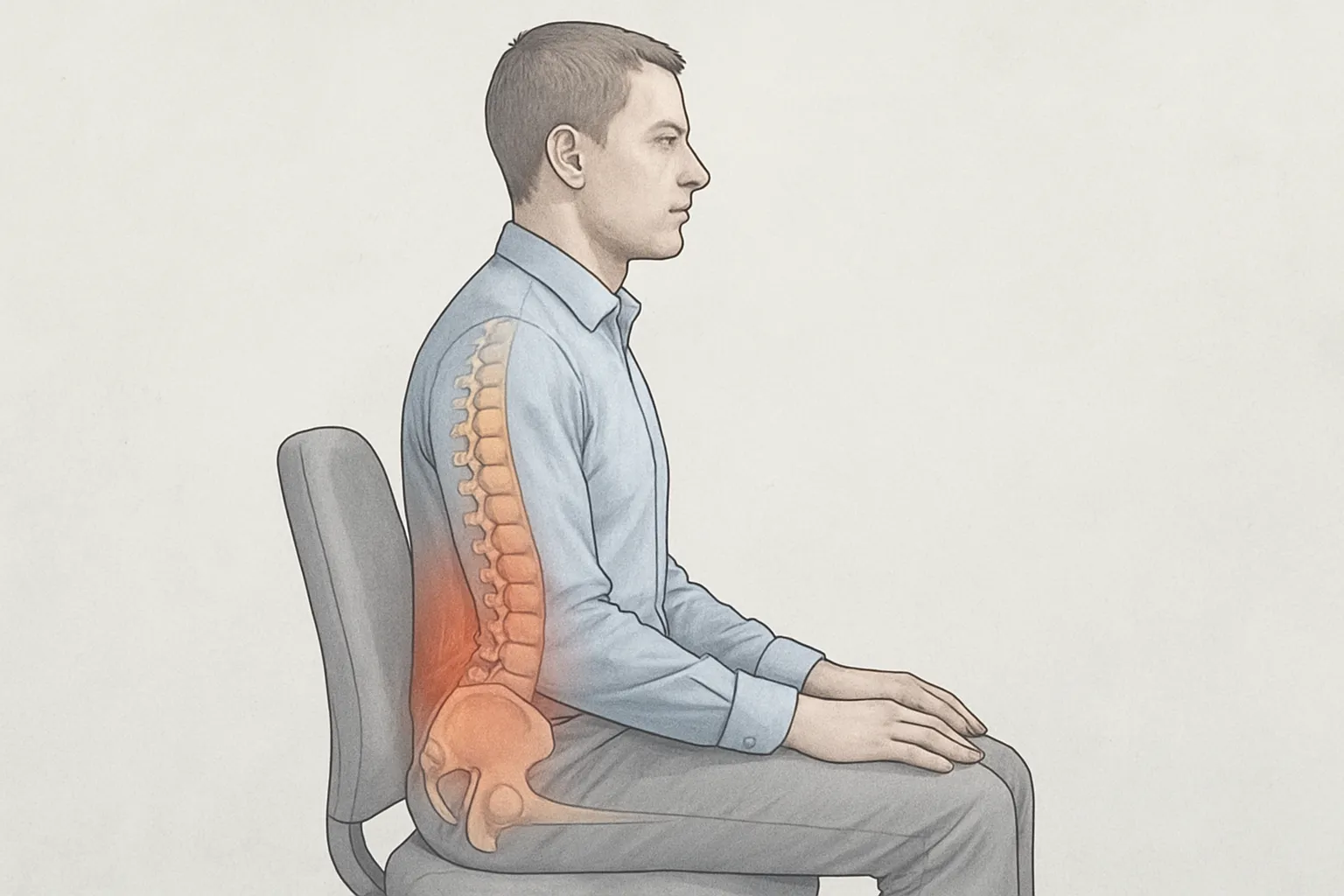
Ergonomics at work and working from home: practical adjustments that can support spinal health
Workstation adjustments (office and home)
A workstation layout that facilitates a neutral stance It can help reduce unnecessary mechanical strain on the spine. The aim is to align the ears, shoulders and hips, distribute body weight and allow for adjustments throughout the day.
- Chair: height that allows the feet to rest flat on the floor; hips and knees at ~90–100°; bottom fully against the seat; lumbar support that respects the natural curve of the spine (a cushion or towel if there is no specific support).
- Desk and armrests: forearms parallel to the floor, shoulders relaxed; wrists in a neutral position for typing and using the mouse.
- Screen: screen alignment with the top edge at eye level and 50–70 cm high; if using a laptop, raise it and use an external keyboard and mouse.
- Keyboard and mouse: positioned close together to minimise reaching; elbows at 90–100°, mouse at the same height as the keyboard.
- Phone and video calls: use headphones or a hands-free kit so you don’t have to hold the phone between your shoulder and neck; position the camera at eye level.
- Lighting: minimise glare to avoid having to tilt your head forward; ensure there is sufficient side lighting and contrast.
Work and exercise habits
As well as the physical layout, daily habits also influence perceived comfort. Enter postural variability y micro-pauses Regular exercise can help manage fatigue and stiffness.
- Vary your position: sit, stand or walk briefly at intervals; if using a height-adjustable desk, start with short periods and increase the duration as tolerated.
- Short breaks: 1–2 minutes every 30–45 minutes to stand up and gently move your neck, shoulders and spine, without any sudden movements.
- Organising your workspace: leave room for your legs; avoid keeping your legs crossed for long periods; keep frequently used items within easy reach.
- Screen and viewing management: vary your focal point periodically to reduce the tendency to lean your head forward whilst performing close-up tasks.
- Signs to watch out for: if the symptoms are persistent, progressive or radiate to other areas, consider an individualised clinical assessment.
Sleeping habits that affect spinal health: posture, mattress and pillow
Sleeping position
Maintain a neutral alignment The position of the head, spine and pelvis reduces unnecessary mechanical stress whilst resting. When lying on your side, it is advisable to keep your hips and knees slightly bent; a soft pillow between your legs can help to limit rotation. When lying on your back, a small pillow under your knees promotes a more comfortable position for the lower back. Lying on your stomach is often associated with cervical rotation and maintain lumbar extension; if this cannot be avoided, it is preferable to use a very low pillow and alternate the position of the head.
Mattress
The aim is a support a uniform support that respects the body’s natural curves without any marked sagging. A mattress that is too soft allows the pelvis and shoulders to sink in excessively; one that is too firm may concentrate pressures at pressure points. Adaptive materials (e.g. memory foam or latex) can help to ensure a more even distribution of pressure, but tolerance varies from person to person and depends on one’s usual sleeping position and body type. As a practical guide, when lying on your side, your spine should be roughly parallel to the surface; if this is not the case, you should reassess the firmness of the mattress or consider using additional supports.
Pillow
Its main function is to maintain the pillow height suitable for keeping the cervical spine in a neutral position. When sleeping on your side, a higher pillow is usually required to compensate for the width of the shoulder and prevent the neck from tilting to one side; when sleeping on your back, a low-to-medium height helps prevent excessive flexion or extension; when sleeping on your stomach, it is best to use a pillow with minimal height or none at all to limit forced rotation. Regardless of the material, it is advisable for the pillow to retain its shape throughout the night and to be replaced when it loses support or shows signs of caking.
Prolonged inactivity: why taking breaks and engaging in moderate exercise are linked to a healthier spine
Sitting still for prolonged periods involves sustained mechanical load on intervertebral discs, posterior joints, ligaments and postural muscles. This lack of variability reduces segmental micro-mobility and muscle pump activity, which contributes to stiffness and low-grade fatigue. In predisposed individuals, this combination is associated with increased sensitivity to load and lumbar or cervical discomfort, without there necessarily being a structural injury.
Short breaks and low-intensity movement introduce postural variability y low-intensity muscle activation, distributing the forces more evenly and promoting the diffusion-mediated disc nutrition. Furthermore, the temporary increase in the perfusion in muscles and connective tissues may help to improve oxygenation and metabolic clearance. Changes in posture relieve the constant strain on facet joints and ligaments, factors associated with a reduced perception of stiffness in many people.
In practice, regularity is usually prioritised over duration: short, frequent breaks involving comfortable movements, without pain or marked fatigue, may be preferable to very sporadic rest periods. The optimal duration varies from person to person; starting with manageable intervals and adjusting them according to your personal response is a sensible approach. Examples of low-impact options that can be incorporated into 1–2-minute sessions include:
- Alternate between sitting and standing, and take a few gentle steps.
- Gentle pelvic tilts and thoracic extensions whilst seated.
- Cervical and shoulder mobility within comfortable ranges.
- Short stretches of the hips and calves, or gentle isometric contractions of the glutes and abdomen.
Lifting and carrying objects: everyday techniques to reduce strain on the spine
To reduce the mechanical strain on your spine when lifting objects, prioritise a neutral column (alignment of the head, chest and pelvis) and uses the hip joint rather than bending mainly at the back. Drive the movement with your legs and glutes, and keep the close-to-body load and centred between both feet. Before you start, check your weight, stabilise your base of support (feet apart and firmly planted) and clear the path ahead to minimise any turns or unsteady steps.
- Move closer to the object and place your feet on either side of it or just in front of it.
- Engage your core (gentle tension) and lower yourself by bending at the hips and knees, keeping your back straight.
- Ensure a stable grip using your whole hand; avoid forcing your fingers into extension.
- Start the lift by extending your hips and knees, without money transfers from the torso; to change direction, pivot on your feet.
- Breathe continuously (exhale whilst exerting yourself) and lower the object close to your body using the same technique.
When carrying things, prioritise symmetry and weight distribution: switch sides if you’re carrying a bag in one hand, use both straps on rucksacks, and adjust the straps to keep the load high and close to your torso. Whenever possible, opt for pushing versus pulling When using trolleys, dividing the load into smaller bundles and taking short breaks can reduce the cumulative strain. Symptoms such as sharp pain, weakness, tingling or radiating pain should not be ignored: stop what you are doing and reconsider the method or the weight being used.
Mobile phone, laptop and tablet use: digital habits that affect the health of the cervical and lumbar spine
Common postural factors
Certain patterns of device use are associated with increased mechanical stress on the cervical and lumbar regions, particularly when these postures are maintained for prolonged periods without any change in posture:
- Sustained cervical flexion when looking at a mobile phone or tablet resting on one’s lap, which puts increased strain on the neck’s extensor muscles.
- Head forward and an increase in thoracic kyphosis when typing on a laptop with a low screen, which contributes to tension in the neck and shoulders.
- Asymmetries by holding the mobile with one hand, typing using only your thumbs, or holding the phone between your shoulder and ear whilst keeping it turned.
- Prolonged sitting without lumbar support (pelvic retroversion) and when used on a sofa or bed; in the prone position, the sustained cervical extension It can also increase perceived stress.
Prudent settings and habits for mobiles, laptops and tablets
Simple steps to basic ergonomics y postural variability can help to adjust the load on the spine, depending on individual tolerance:
- Mobile: bring the device close to the eye level whenever possible; alternate hands and grips; use a headset for calls rather than holding the phone between your shoulder and head; share the typing between both hands or use voice dictation if you find it comfortable.
- Laptop: raise the screen (using a stand or books) and use an external keyboard and mouse to avoid straining your neck; rest your forearms; keep your hips and knees at comfortable angles with your feet flat on the floor; if using on a sofa or bed, limit the time spent there and use lumbar support.
- Tablet: Choose a desk stand rather than using the device on your lap; if using a keyboard, set it to “mini-laptop” mode by raising the screen; alternate between the stylus and the keyboard to break up repetitive movements.
- All devices: enter micro-breaks and changing your posture regularly (for example, for 1–2 minutes every 30–45 minutes); alternating between sitting, standing and taking short walks; performing gentle neck and spine movements within a comfortable range; adjusting text size and brightness to avoid leaning your head in.