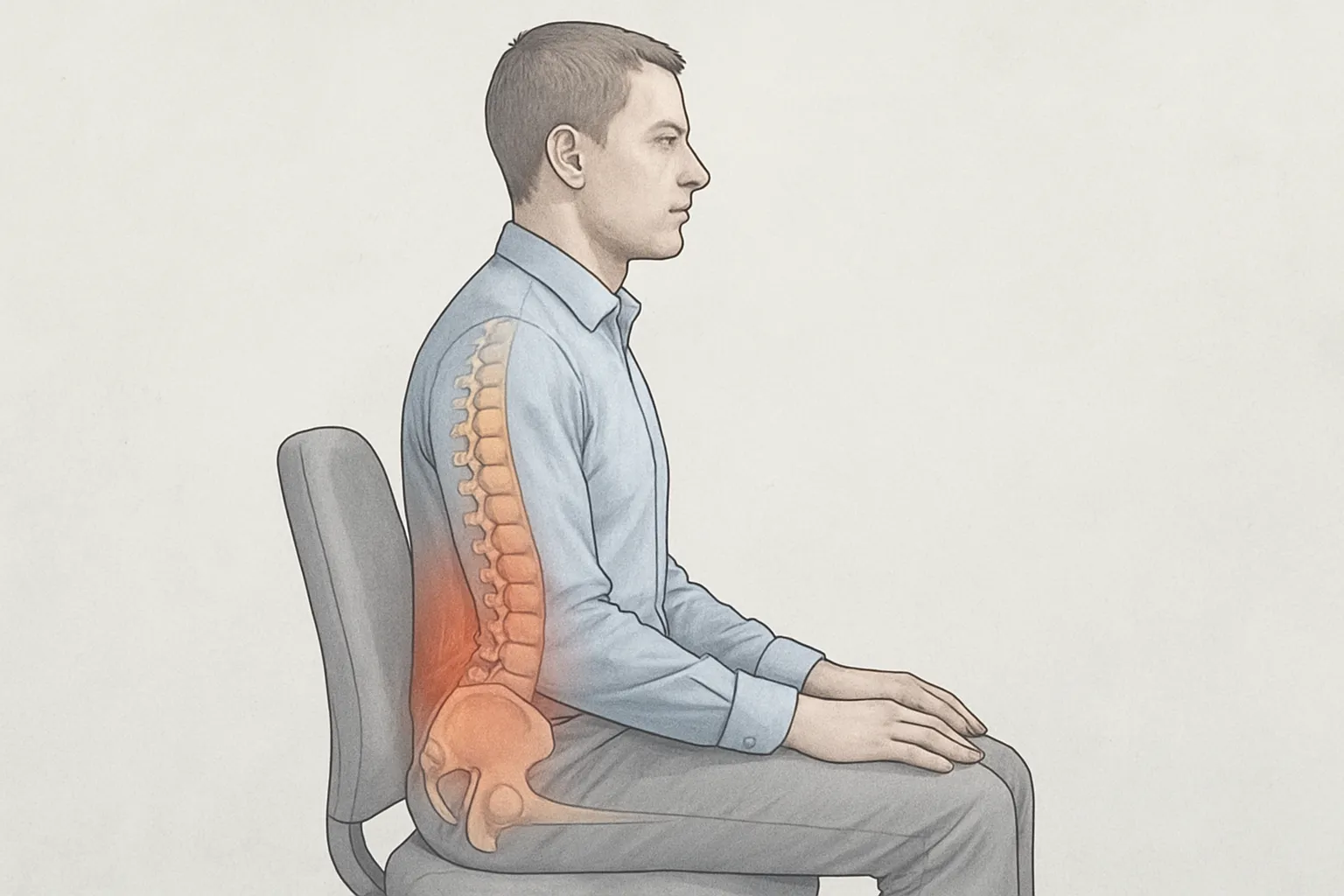
What is prolonged posture and how can it affect spinal health?
The prolonged posture is the maintenance of the same body position - sitting, standing, or with the trunk held in flexion or extension - for extended periods of time, with relative immobility and little variation in support. It involves low level isometric muscle contractions and limited joint mobility, conditions that can accumulate load on certain tissues without allowing sufficient recovery.
From a biomechanical point of view, maintaining a fixed position may modify the mechanical load distribution on the intervertebral discs, The exposure of the facet joints and ligaments. Sustained exposure favours the phenomena of “skin damage".“creep”or viscoelastic deformation in connective tissues, together with muscle fatigue of the paravertebral and scapular musculature. These processes can be associated with stiffness, a feeling of overload and reduced accuracy of the motor control, increasing susceptibility to vertebral discomfort in some people.
The influence on the health of the spine is not uniform and is dependent on individual factors (pain history, strength and endurance capacity, sleep, stress), environment (ergonomics, vibration, temperature) and task (physical demand, asymmetries, use of loads). In general, a lower postural variability is associated with increased localised load accumulation and over time may promote episodes of pain or discomfort; the repeated presence of morning stiffness, pain that increases at the end of the day or a feeling of sustained local fatigue are signs that exposure to unchanged postures may be influencing the spine.
What happens to discs, muscles and ligaments with prolonged posture: a biomechanical overview
Intervertebral discs
With the position maintained, the sustained load in compression and shear acts on the intervertebral disc. The nucleus pulposus tends to transiently lose water and the annulus fibrosus undergoes time-dependent deformation (creep), with a slight reduction in disc height that gradually recovers as the load is varied. The lower mechanical oscillation limits the “pumping” of fluids, which may reduce the nutrient exchange through the endplates. These responses are to be expected in tissues viscoelastic and do not in themselves imply harm, but they do modify the distribution of the stress between layers of the ring and the posterior joints.
Muscles
Maintained low-level isometric contractions reduce the perfusion and promote the accumulation of metabolites, which can be perceived as fatigue or stiffness. The low motor variability prolongs the activation time of the same motor units and increases the passive stress of the intramuscular connective tissue. If the muscle remains shortened or elongated for long periods of time, mechanical disadvantage appears in the relationship length-voltage, with greater effort to generate the same force and sensation of myofascial stiffening.
Ligaments and capsules
The ligaments and joint capsules show viscoelastic behaviour: at prolonged submaximal loads, the following occurs creep y stress relaxation, with transient increase in laxity and decrease in immediate resistance to stretching. Recovery after unloading is gradual and time-dependent. In positions close to the end of range, the combination of compression and shear can concentrate tensions in the insertions, and sustained stimulation of the mechanoreceptors can temporarily modulate proprioceptive sensitivity.
Common discomforts and warning signs linked to spending too much time in the same position
Prolonged immobility favours the sustained muscle tension, the venous stasis and the sustained compression of tissues and nerves, This can manifest as pain, stiffness and sensory disturbances in different regions of the body.
Frequent discomfort
- Stiffness and pain in the neck, back or lumbar region after sitting or standing for long periods.
- Shoulder tension and tension-type headache.
- Transient paraesthesias (tingling or numbness) in the hands, buttocks or legs that subside when changing position.
- Heaviness and slight swelling in the ankles due to slowing of venous return.
- Temporary decrease in range of motion and a feeling of “stiffness”.
- Skin irritation or pressure discomfort in support areas (buttocks, sacrum, heels).
Warning signs
- Severe, progressive or sleep-interrupting pain.
- Persistent tingling or loss of sensation accompanied by weakness or motor clumsiness.
- Low back pain radiating to one leg and neurological deficits (loss of strength, reflex disturbances) or changes in sphincter control.
- Marked, asymmetrical swelling, warmth or redness in one leg; discolouration changes or distal coldness.
- Sudden shortness of breath, chest pain or coughing up blood after periods of immobility.
- Pressure sores (ulcers), pale or purplish skin at pressure points, or fever associated with back pain or skin wounds.
Ergonomic measures and active breaks to reduce the impact of prolonged posture on the spine
An adjusted workstation seeks to keep the spine in neutral alignment and distribute loads more evenly. It is recommended that the chair be adjusted so that the hips and knees are at approximately 90-100°, with feet resting on the floor or footrest; use lumbar support The upper third of the monitor should be at eye level and about an arm's length away, and the keyboard and mouse should be placed close together, with forearms parallel to the floor and shoulders relaxed. Avoid sustained cervical flexion, thoracic stoop and repeated twisting of the trunk; if possible, alternate periods of sitting and standing without prolonging either position excessively.
Active breaks are short interruptions with gentle movement that can help mitigate stiffness and promote tissue recovery without adding significant fatigue. In clinical and occupational settings, it is often advisable to introduce micro-pauses frequent (e.g., every 30-60 minutes) and to encourage the postural variability throughout the day. Movements should be performed within a comfortable range, without pain or bouncing, with quiet breathing. Duration and intensity are adjusted progressively according to individual tolerance and the demands of the task.
Examples of low-impact active breaks targeting the spine and related chains:
- Smooth glides and cervical rotations, returning to forward gaze between repetitions.
- Scapular retractions and shoulder elevation-depression to activate the shoulder girdle.
- Thoracic extension with the middle of the back resting on the backrest and opening the chest.
- Sitting or standing pelvic tilts to modulate lumbar mobility.
- Short stretching of hip flexors (short stride) and posterior chain without rebound.
- On-site gait, heel raises and ankle mobility to promote distal activation.
When to consult a health professional for back pain related to sustained postures
Back pain related to sustained postures (e.g. prolonged sitting or static work) is often mechanical and variable; however, it is considered prudent to seek clinical assessment when back pain is associated with persistent pain lasts more than 2-4 weeks, occurs recurrently, interferes with sleep, or causes functional limitation noticeable in basic activities. It also merits assessment if it progressively worsens despite reasonable adjustments of posture or regular breaks, or if it appears suddenly and intensely without clear exertion.
Warning signs requiring priority assessment
- Neurological deficitsweakness in the legs, loss of sensation, persistent tingling, unsteady gait or foot drop.
- Pain radiating to one or both legs with loss of strength, or associated with sphincter disturbances (retention or incontinence) or “saddle” anaesthesia.
- Systemic symptomsFever, chills, malaise or unexplained weight loss.
- Trauma recent fall or accident, constant nocturnal pain that does not subside at rest, sudden deformity or prolonged morning stiffness.
- Relevant history: cancer, osteoporosis, long-term corticosteroid use, recent infection.
- Older age or under 18 years with new and persistent pain.
Although the onset appears to be linked to sustained postures, certain situations increase the risk and warrant clinical evaluation: pregnancy or recent postpartum, immunodeficiency (including poorly controlled diabetes), use of drugs or conditions affecting bone or immunity, and work with high static load when pain is accompanied by numbness, weakness or progressive limitation. A clinical assessment can identify red flags and rule out non-mechanical causes where appropriate.