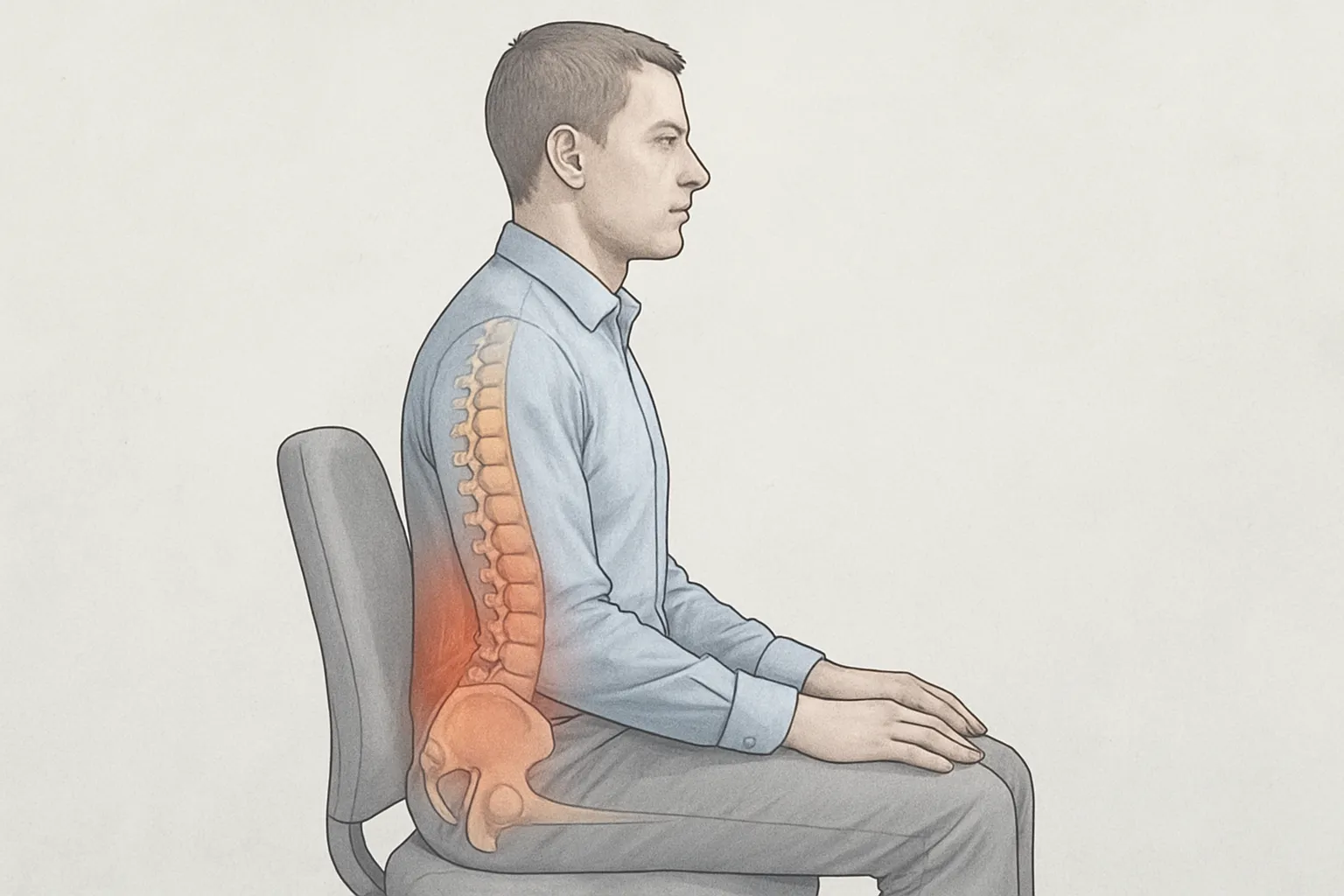
How daily habits affect body posture: what happens to the muscles, joints and spine
Muscles
Daily postural habits place a mechanical load repeated, which induces tissue adaptation. Over time, some muscle groups become relatively shortened (for example, hip flexors during prolonged sitting), whilst others remain in a sustained state of elongation. This can alter the basal tension and coordination between synergies, promoting compensatory strategies and low-intensity exercise in everyday activities.
Joints
Movement promotes the exchange of synovial fluid and the nourishment of cartilage; conversely, prolonged immobility tends to reduce the range of movement normal and to increase the sensation of capsular stiffness. The continuous repetition of movements within limited ranges of motion reinforces preferred movement patterns and may make the load distribution on the articular surfaces when the same movement patterns are always used.
Spine
The column acts as a system of physiological curvatures y intervertebral discs which distributes forces. Habits such as keeping the head tilted forwards or carrying weight asymmetrically prolong specific segmental flexions or extensions: the discs experience variations in pressure and hydration throughout the day, and the passive tissues show viscoelastic flow. When a posture is maintained for a long time, stress is more likely to be concentrated in specific areas; varying one’s posture throughout the day redistributes that stress across different body segments and tissues.
Ergonomics in remote working and screen use: sedentary habits that can affect body posture
The held postures whilst working from home and prolonged screen use encourage patterns such as head forward, shoulder protraction y lumbar flexion maintained. These patterns reduce the postural variability and can increase the mechanical strain on the tissues of the neck, shoulder girdle and lower back. Prolonged visual focus and the effort required to read from small screens tend to increase cervical flexion and fatigue in the stabilising muscles, leading to postural compensations.
Among the most common sedentary habits that affect posture are:
- Working with the monitor underneath out of line with the eyes or too far to one side, which causes sustained cervical flexion or rotation.
- Use of laptop on the sofa or bed, which encourages a hunched posture and insufficient lumbar support.
- Keyboard and mouse at a distance or high, encouraging raised shoulders and sustained wrist extension.
- Support the phone wedged between his shoulder and ear or looking at your mobile phone whilst repeatedly bending your neck at a sharp angle.
- To sit on chairs without adjustment or a lack of lumbar support or foot support, or remaining in a position where legs crossed on an ongoing basis.
- Lighting and screen glare which force you to lean in or get closer to see clearly.
Organisational factors also play a part: long blocks without micro-pauses, a lack of task variation and a lack of changes in posture contribute to fatigue and stiffness, which in turn perpetuate slouching patterns. The combination of sustained stress and a high cognitive load can increase tension in the trapezius muscles and cause shallow breathing, reducing thoracic mobility and affecting cervical and scapular alignment whilst working at a computer screen.
Sleep routines, mattresses and pillows: their role in postural alignment and in conditions such as neck pain
Postural alignment during sleep
Maintain a neutral alignment of the head, neck and spine whilst resting can reduce unnecessary mechanical stress on cervical tissues. In general, the lateral and supine positions allow for a more predictable alignment than the prone position, which tends to force cervical rotation and extension. Common signs of misalignment include waking up with stiffness or noticeable tender spots. Small, gradual adjustments are usually more tolerable than sudden changes.
Mattress and pillow: support and height
A mattress with support A well-fitting one allows the shoulders and hips to give way sufficiently without excessive sinking, helping the spine to maintain its natural curves without twisting. The pillow height It should be approximately the same as the distance between the neck and shoulder when lying on one’s side, to keep the head aligned; when lying on one’s back, a thinner pillow that does not cause the head to tilt forwards is usually preferable. Materials and firmness levels may vary depending on body shape and personal preferences, and it is common to need a period of adjustment to assess comfort and how the materials respond.
- Side-sleeping: a pillow to fill the gap between the neck and shoulder; if the hips sink in slightly, a pillow can be placed between the knees to prevent pelvic rotation.
- Supine position: a low pillow that supports the cervical curve without forcing the neck into flexion; some people can tolerate a small cervical roll.
- Prono: this tends to increase cervical strain; if it cannot be avoided, minimising the height of the pillow and alternating the side on which you lie can help reduce sustained rotation.
Sleep routines and neck pain
The sleep hygiene It influences pain perception and tissue recovery. Regular sleep schedules, a wind-down routine before bed, and a quiet, dark environment at a moderate temperature are associated with fewer micro-awakenings and less time spent in sustained postures that may irritate cervical structures. Limiting stimulants and screen time in the hours leading up to bed, as well as avoiding heavy meals and alcohol, can promote more uninterrupted sleep, which helps improve tolerance to nocturnal postural stresses, although this does not guarantee therapeutic effects.
Footwear, handbags and the way we carry weight: everyday effects on body posture and balance
Footwear
Footwear alters the foot-ground interaction and, consequently, postural control. The height of the heel shifts the centre of gravity forwards, increasing the demand for stabilisation in the ankle, knee and lower back; very soft or unstable soles can increase rolling motion whilst standing still, whilst very stiff soles reduce adaptation to the terrain and proprioceptive feedback. A firm heel counter and a proper fit limit heel slippage, and a toe box with sufficient space prevents restrictions on the toes that affect propulsion and balance. Uneven wear on footwear may be associated with asymmetrical load-bearing patterns along the kinetic chain.
Bags and how to carry weight
The way in which bags and rucksacks are carried exerts forces on the spine and the shoulder girdle. Lateral loads (bags carried on the shoulder or across the body) tend to cause the trunk to tilt and rotate in order to compensate for the imbalance, placing greater strain on the paravertebral and neck muscles. Rucksacks with two shoulder straps, worn close to the body, reduce the moment of strength on the spine by shortening the distance between the load and the body’s centre of gravity; very long shoulder straps or a low load position increase this lever arm. The total weight, the duration of carrying and the frequency of use all influence fatigue, which can affect gait and stability.
When analysing these factors in everyday life, certain principles of mechanics and load tolerance prove useful:
- Support base: Wide, stable contact surfaces tend to facilitate postural control during static tasks; very narrow or sloping surfaces require greater adjustments.
- Symmetric distribution: Distributing the load between both sides of the body tends to reduce asymmetries; when this is not possible, alternating sides helps to minimise unilateral strain.
- Proximity of the load: Holding a weight close to the torso and at mid-body height reduces the torque on the spine compared with holding it further away or carrying it too low.
- Adjustment and time: a fit that prevents slipping and prolonged exposure is associated with reduced fatigue and postural variations.
- Individual variability: Age, physical condition, history of pain or instability, and the type of surface all affect postural response, which is why tolerance levels vary from person to person.
Stress, breathing and breaks in movement: habits that could influence postural tension throughout the day
Stress and muscle tone
The stress sustained is associated with greater sympathetic activation, which can increase basal muscle tone, particularly in the neck, jaw, shoulders and lower back. This alert response, whilst useful in the short term, may encourage patterns of co-contraction and muscle “tension” when it coincides with prolonged and demanding tasks. Furthermore, heightened bodily awareness and poorer sleep quality can amplify the perception of stiffness. Susceptibility varies from person to person and is influenced by factors such as workload, rest and a history of pain.
Breathing and cervical load
Under pressure, it is common for a upper thoracic breathing pattern, with shorter, faster breaths that engage the accessory muscles (sternocleidomastoid muscles, scalene muscles, upper trapezius). This pattern may increase the mechanical demand on the shoulder girdle and the cervical region, and may coexist with reduced diaphragmatic involvement. The interaction between breathing and posture is bidirectional: certain positions either facilitate or hinder thoracic and abdominal movement, whilst ventilatory mechanics, in turn, influence the sensation of tension in the upper body.
Pauses in movement and postural variability
Breaking up periods of inactivity with changes of position and gentle movements introduces postural variability, which could reduce the cumulative mechanical load on the same muscle groups and promote tissue perfusion. In settings involving prolonged work, short, regular breaks are generally more feasible than long, infrequent breaks, and may include alternating between sitting and standing and low-intensity joint mobility. The response to these strategies is not uniform; any adaptation must take into account the task at hand, individual preferences and any relevant health conditions.