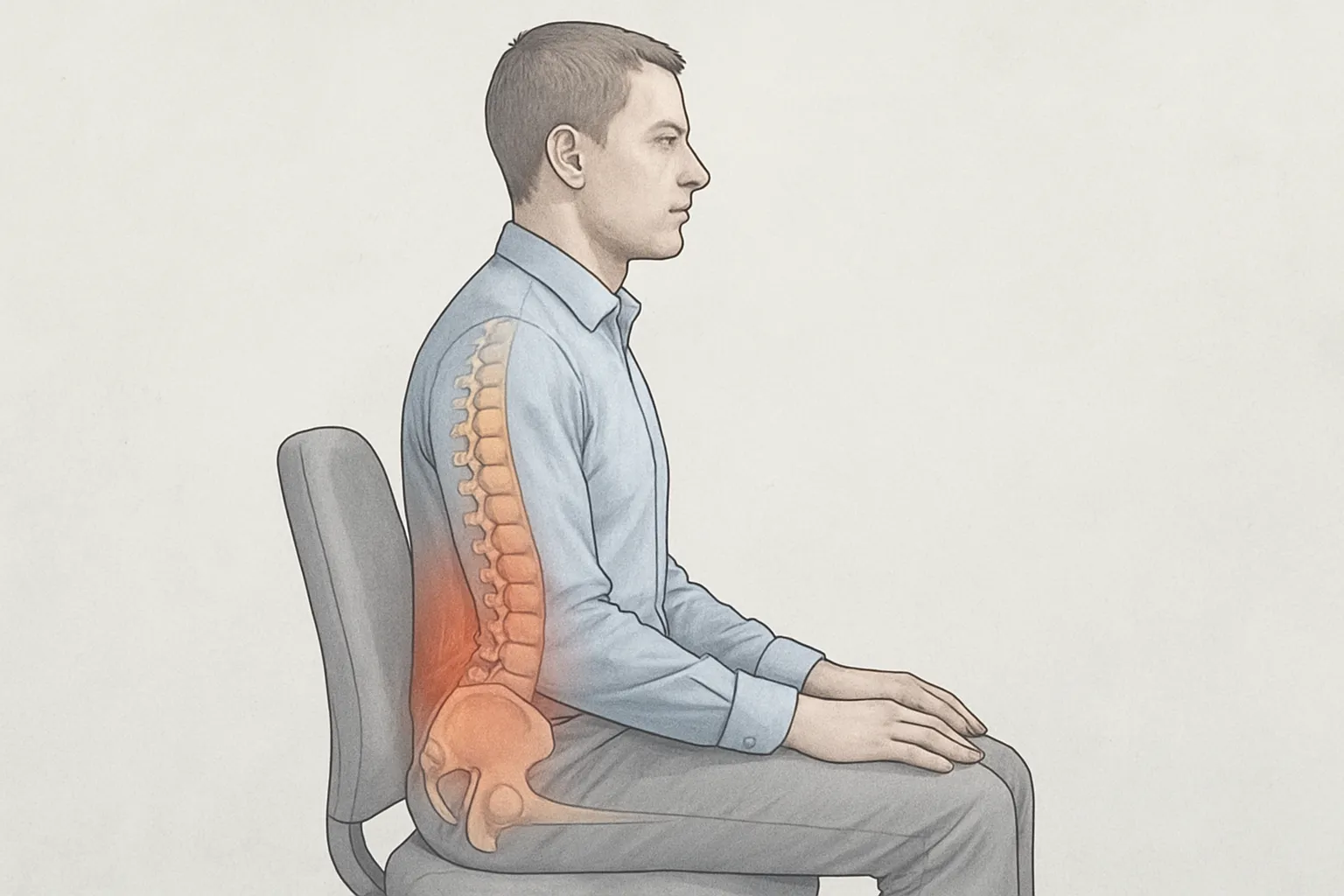
Postural habits from infancy to adulthood: definition and relationship to musculoskeletal health
Clinical definition of postural habits
The postural habits are learned patterns of positioning and movement that we adopt repeatedly during everyday activities (sitting, standing, carrying, sleeping, screen use). The position is dynamic and adjusts continuously according to task, fatigue and environment; there is no single “correct posture” applicable to all individuals or stages. These habits are shaped by the motor development, They evolve from childhood to adulthood.
Relationship to musculoskeletal health across the lifespan
In conjunction with strength, physical condition, rest and psychosocial factors, postural habits influence the musculoskeletal health by modulating how the mechanical load on muscles, joints and tissues. Depending on individual tolerance, certain sustained positions or repeated tasks may be associated with discomfort or fatigue, while postural variability and progressive dosing of the load favour adaptation in many people. This relationship is multifactorial and does not in itself determine the presence or absence of pain.
- Childhood and childhood: encourage active play and motor exploration; furniture that allows for foot support and alternating positions; well-fitting backpacks with distributed loads; frequent breaks from screen use.
- Adolescencegrowth spurts can alter proprioception; adjust study stations, alternate sides when loading and progress sport loads gradually, watching for signs of overload without alarmism.
- AdulthoodIn sedentary jobs or jobs with repetitive tasks, alternate sitting and standing, introduce micro-breaks and vary postures; complement with general conditioning to increase tolerance to work and domestic demands, adapting according to symptoms and objectives.
Expected postural changes by stage (childhood, adolescence and adulthood) and influencing factors
Childhood
In infancy, physiological variations in alignment are common and usually resolve with development, such as the passage from genu varum a genu valgo mild, the femoral anteversion marked and the flexible flat feet. The curvatures of the spine are progressively defined: lumbar lordosis and thoracic kyphosis may appear to be more accentuated at certain times by the head-to-trunk ratio and the ligament laxity characteristic of the stage. Motor coordination and postural tone are maturing, so transient patterns are common without necessarily implying pathology.
Adolescence
During the accelerated growth temporary imbalances between muscle length and strength may appear, with a tendency to project head and shoulders forward and to vary lumbar lordosis. Structural asymmetries may become evident during this period, such as the idiopathic scoliosis or structured hyperkyphosis, especially when growth is rapid. Sustained loads and prolonged exposure to screens are associated with sustained postures that may become entrenched if they persist, although their impact varies between individuals.
Adulthood
Posture tends to stabilise and adapt to the demands of work, sports and care. Factors such as repetitive work, unilateral loads or prolonged sedentary periods favour specific adaptations in the shoulder girdle, spine and hips. As the years go by, age-related changes are observed, such as a gradual reduction of the disc hydration and the muscle mass and strength (sarcopenia), which may be accompanied by increased thoracic kyphosis in later life. In stages such as pregnancy, the centre of gravity is displaced and usually transiently increases lumbar lordosis.
Cross-cutting influencing factors:
- Genetics and morphotype: body proportions, joint laxity and family history.
- Growth and hormones: rate of growth spurts and pubertal changes that modify tissues and coordination.
- Physical activity and strength: exposure to repeated gestures and balance between mobility and motor control.
- Ergonomics and sedentary time: height of surfaces, position of screens, pauses and postural variability.
- Body weight and composition: load distribution and demand on the spine and lower limbs.
- Vision, breathing and oral health: cephalo-cervical and thoracic compensations for sensory or functional deficits.
- Pain and history of injury: antalgic strategies that alter patterns of support and alignment.
- Footwear and support surface: influence on the mechanics of the foot and the ascending chain.
Practical ergonomics for studying, working and using screens without neglecting postural habits throughout life.
Workstation and screens
Adjusting the environment seeks a neutral stance and stable, with comfortable lumbar support, feet firmly on the floor or footrest and shoulders relaxed. Keyboard and mouse close to the body to avoid raising the shoulders; wrists in neutral position. The height of the screen in view (top at eye level or slightly below) and a distance of approximately one arm's length helps to reduce sustained neck bending. On laptops, it is advisable to raise the computer and use external peripherals where possible to reduce cervical flexion. Uniform, glare-free lighting and increased font size if needed contribute to more comfortable reading.
Breaks and exposure load
Time management in front of screens benefits from regular breaks and the variability of movement rather than holding one posture for hours at a time. A practical guideline is to intersperse short micro-pauses every 30-45 minutes to change posture, stand up or gently move neck, shoulders and hands, adjusting to individual tolerance. For visual rest, the “20-20-20 rule”The following is the principle of the "look at a distance of about 6 metres for about 20 seconds after 20 minutes of continuous work, supplemented by conscious blinking and brightness/contrast control.
Life-long adaptations
In childhood and adolescence, it is advisable to have adjustable furniture that accompanies growth, with screens at eye level and long study times split up to avoid static loads. In adulthood it is often key to balance work and domestic demands: alternate tasks, use simple solutions (e.g., raise screen, support forearms) and review teleworking habits. Older people may require larger sources, higher contrast and indirect lighting to reduce glare; stable surfaces and good cable management reduce environmental risks while maintaining a workstation layout that encourages frequent posture changes.
Physical activity, mobility and strengthening that can promote healthy postural habits in different age groups
Childhood and adolescence
Variety of movement and active play can encourage postural habits useful in the long term by stimulating the motor control and coordination. Running, climbing, throwing and weight-bearing exercises (e.g. squats, push ups, rowing with bands) are often appropriate if technique is prioritised. Include joint mobility The use of hip, ankle and thoracic spine exercises, together with diaphragmatic breathing and simple balance tasks, helps to maintain functional ranges and efficient alignment in study and sport, without the need for intense loads or early specialisation.
Adulthood
In stages with sedentary lifestyles or repetitive tasks, alternating the day with short mobility breaks (thoracic extensions, gentle cervical rotations, hip hinges) and 2-3 weekly global strengthening sessions can support daily postural tolerance. It is useful to emphasise back chain (buttocks, hamstrings, spinal erectors), scapular musculature, trunk strength y balance, with progressive and controlled loads. The gradual progression and attention to the quality of movement are preferable to rapidly increasing volume or intensity, especially in the face of previous discomfort.
Older people
A multicomponent approach with walking or low-impact aerobic activity, gentle mobility and task-oriented strength (standing, climbing steps, carrying light loads) can contribute to the maintenance of postural stability and efficiency in daily life. The work of balance and proprioception (unipodal supports with close support, changes in base of support) and regular practice within comfortable ranges facilitate postural adjustments to disturbances. Intensity should be adapted to the individual condition, assessing safety and, where required, professional supervision for history of falls, persistent pain or comorbidities.
Warning signs and situations that often prompt clinical assessment in relation to postural habits from infancy to adulthood
Infancy and childhood
At this stage, signs are often related to motor development and body symmetry; some findings warrant clinical assessment to rule out structural or neuromuscular disorders.
- Persistent pain back, neck or shoulder pain not explained by clear trauma.
- Progressive asymmetries (shoulders or hips at different heights, rib prominence, trunk tilt).
- Motor retardation or regression (difficulty in maintaining a seated position, unsteady gait outside the expected range for age).
- Persistent tiptoeing beyond early childhood or frequent falls.
- Functional limitation for games or physical education due to discomfort when carrying a backpack or sitting.
- Signs of night pain, unintentional fever or weight loss together with musculoskeletal complaints.
Adolescence
Changes in growth and increased screen time may reveal postural problems or underlying conditions that should be clinically differentiated.
- Recurrent low back or neck pain associated with held positions, lasting several weeks or limiting activities.
- Visible worsening of posture (hyperkyphosis, increased “hump”, winged scapulae) or progression of asymmetries.
- Tension headaches Frequent, prolonged use of screens, with neck stiffness.
- Paresthesias (tingling) or weakness in arms or legs, or radiating pain.
- Red flagspersistent nocturnal pain, history of significant trauma, fever or neurological symptoms.
Adulthood
In adults, prolonged work and leisure habits may interact with physical and psychosocial factors; certain manifestations prompt clinical assessment.
- Back or neck pain that does not improve with usual measures and affects day-to-day performance.
- Prolonged morning stiffness or inflammatory, or pain that awakens at night.
- Range of motion limitation, a feeling of instability or disproportionate muscle fatigue after sedentary tasks.
- Neurological symptoms (numbness, loss of strength, gait disturbance) or pain radiating to the extremities.
- History of frequent relapses repetitive loads or postures, or the constant need to adapt the workstation due to discomfort.
- Accompanying systemic signs: fever, unintentional weight loss, a history of cancer or recent trauma.