The importance of postural control in the early stages: what it is and how it influences child development
What is postural control?
The postural control is the ability of the neuromusculoskeletal system to maintain the stability and guidance of the body at rest and in motion. This is achieved through the integration of sensory systems (vestibular, visual and somatosensory) with motor responses that adjust the postural tone, alignment and proximal stability. It includes anticipatory and reactive postural adjustments, and depends on the maturation of the central nervous system, musculoskeletal strength and flexibility, motor experience, and the environment in which the child moves and explores.
How it influences child development
Increasingly efficient postural control is associated with the acquisition and refinement of major milestones and functional skills that facilitate safe exploration and participation in play. The areas it influences include:
- Transitions and stable postures (head control, sitting, standing, walking).
- Eye–hand coordination and bimanual manipulation, by providing a stable base for distal movement.
- Modulation of muscle effort and motor control by reducing excessive postural compensations and variations.
- Interaction with the environment (range, turning, changes of direction) with greater flexibility and control.
The individual variability The spectrum of developmental trajectories is broad. Factors such as prematurity, differences in muscle tone, limited movement experiences due to prolonged periods of restraint, and neurological or orthopaedic conditions can influence the pace and quality of postural control. Signs warranting clinical observation include persistent postural asymmetries, marked preference for one side, difficulty varying postures, noticeable rigidity or flaccidity, frequent falls when attempting to remain upright, or significant distress when changing position. Providing safe opportunities for floor play and movement in different positions, including supervised tummy time in accordance with paediatric recommendations, can promote meaningful sensorimotor experiences without forcing individual rhythms.
The relationship between postural control and motor milestones: sitting, rolling over, crawling and maintaining balance in the early years
To sit down
The ability to sit unaided usually develops between approximately 6 and 8 months, although there is considerable variation. It depends on the development of the postural control in the head and trunk to maintain an upright posture and make adjustments in response to minor disturbances. The ability to align the pelvis, engage the trunk and deploy protective reactions Using one’s arms allows the child to support their body whilst freeing their hands for exploration, integrating vestibular, proprioceptive and visual information.
To turn round
Rolling over usually occurs at around 4–6 months and requires weight transfer and coordination between the shoulder girdle and the pelvic girdle. The progression of the straightening reactions It helps the head and trunk to orient themselves in space during rotation, whilst segmental control reduces block-like movements. This postural coordination promotes more efficient transitions between the supine and prone positions.
Crawling
Crawling on all fours, which often occurs between 7 and 10 months, requires proximal stability of the shoulder girdle and pelvis to maintain a criss-cross pattern. Constant changes in support require anticipatory postural adjustments and mechanisms that regulate the centre of gravity within a changing base of support. Factors such as muscle tone, muscle strength and sensory integration influence the variability of the movement pattern without implying a single trajectory.
Maintaining balance
During early standing and walking (around 12 months or older, although this may vary), balance depends on ankle and hip strategies, as well as the flexible integration of vestibular, visual and somatosensory signals. The maturation of the equilibrium reactions It enables the assessment of more significant disturbances and irregular surfaces. Marked asymmetrical patterns, persistent block movements or a sustained absence of protective responses may be considered clinical warning signs in postural development.
Early signs and risk factors that may indicate difficulties with postural control
Early signs
- Delays in engine milestones (for example, holding up their head, rolling over, sitting up unaided or starting to walk later than expected for their age).
- Hypotonia or rigidity perceived, with difficulty stabilising the trunk and head in sustained positions.
- Unsteadiness when sitting down or standing up, marked postural fluctuations, frequent falls or motor clumsiness in everyday activities.
- Dizziness when changing position, poorer balance in the dark or on uneven surfaces, and postural fatigue (pain or fatigue when maintaining certain postures for long periods).
Risk factors
- Prematurity and complex perinatal history.
- Neurological conditions (e.g. cerebral palsy, stroke, Parkinson’s disease, multiple sclerosis), vestibular disorders y impaired vision significant.
- Chronic pain, hyperlaxity, weakness in the trunk, and musculoskeletal injuries (ankle, knee, spine) that compromise stability.
- A sedentary lifestyle, old age and frailty with a loss of muscle mass and strength, polypharmacy or sedative medicines, alcohol consumption or the use of other substances.
- Comorbidities such as diabetes with neuropathy, obesity and states of anxiety or fear of falling which alter the postural response.
The presence of these signs or factors does not in itself establish a diagnosis. Their interpretation must take into account each person’s age, functional context and medical history in order to distinguish between developmental variations, physical deconditioning or other disorders that may affect postural control.
Practical recommendations for promoting healthy posture in everyday life
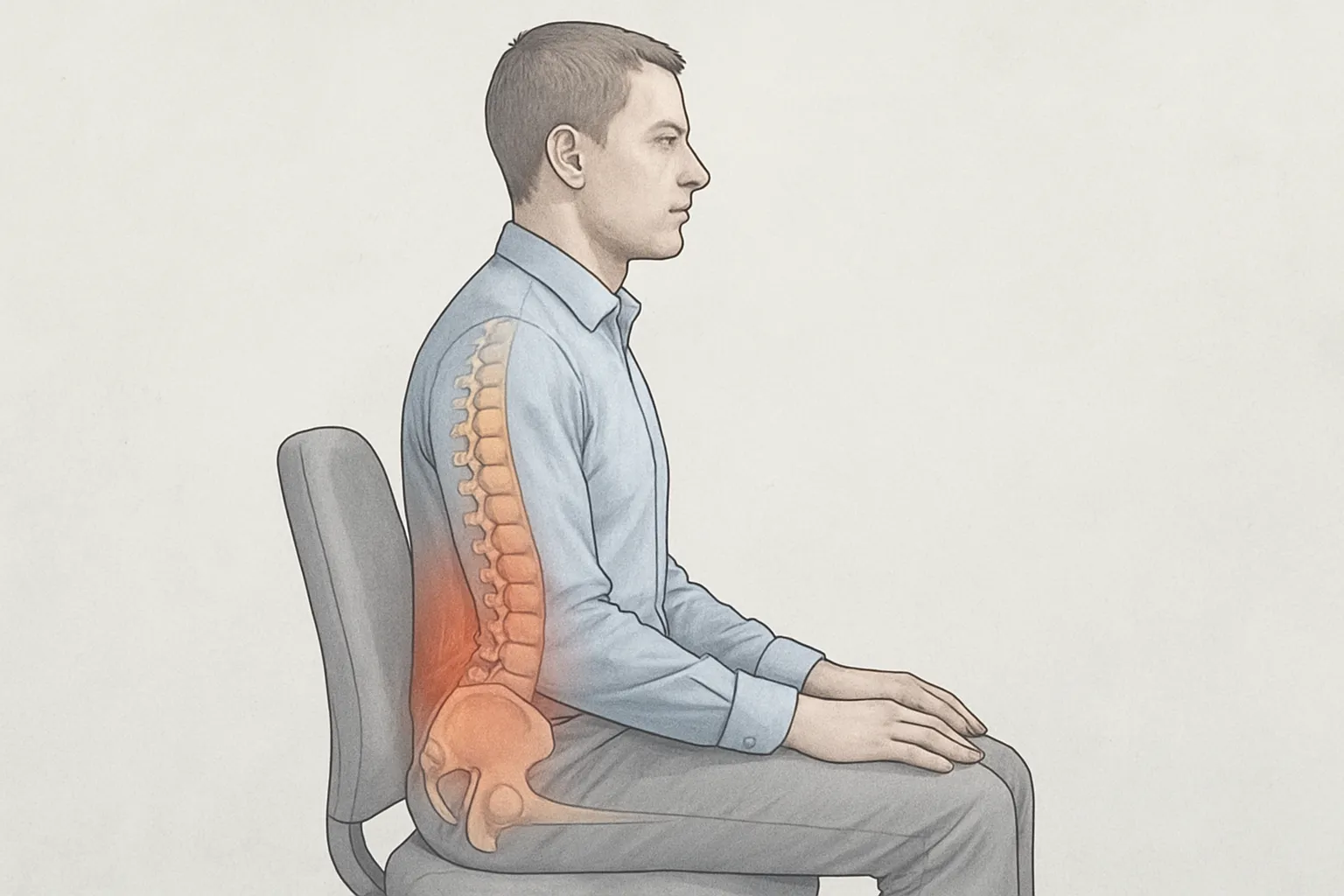
Maintain a healthy posture In everyday life, the focus is usually more on consistency and variety than on a “perfect posture”. Adjusting the working environment to encourage a neutral alignment (screen at eye level, elbows at around 90°, feet flat on the floor and the lower back comfortably supported) can help reduce unnecessary strain. It is helpful to alternate positions (sitting, standing, walking) and to carry out active breaks Regular, gentle movements of the neck, shoulders, thoracic spine and hips. Distributing the weight of handbags or rucksacks evenly, wearing sturdy footwear and ensuring good lighting so as not to strain your eyes all help to reduce prolonged tension.
Daily exercise, based on prudent clinical criteria, usually includes strength and mobility of the trunk, hips and shoulder girdle, prioritising comfortable ranges of motion and gradual progression. Incorporate diaphragmatic breathing control may help improve trunk coordination and reduce perceived chest stiffness. Simple exercises such as proprioception and balance (for example, standing on one leg near a point of support) help with postural fine-tuning. Gradual exposure to tasks that require maintaining certain postures (studying, driving, caregiving) allows the body’s tissues and nervous system to adapt without unnecessary strain.
The self-regulation It is essential to: adjust the level of activity according to how tired you feel, alternate tasks, stay hydrated and prioritise a restful night’s sleep; comfortable sleeping positions, such as lying on your side with a pillow that keeps your head and neck aligned, can reduce perceived tension. It is advisable to pay attention to alarm signals such as pain that does not improve with relative rest, loss of strength, persistent tingling, dizziness or night-time pain that disrupts sleep, as these require an individualised clinical assessment. In general, small, sustained adjustments and frequent changes in posture are usually associated with improved postural tolerance over time.
Assessment of postural control in paediatrics: what to expect during a consultation and common intervention approaches
What to expect at a consultation
In a clinical assessment of paediatric postural assessment it includes a medical history detailed (pregnancy and childbirth, neurological and orthopaedic history, development milestones, falls, fatigue, participation in school activities and play). The assessment usually involves observing static and dynamic posture (sitting, standing, walking and transitions), segmental alignment, muscle tone, range of motion, functional strength and coordination. The following are assessed: straightening and balancing responses and the contribution of the systems visual, vestibular and somatosensory to maintain stability. Where appropriate, the following may be used age-validated standardised tests to objectively assess performance and establish a baseline. Footwear, orthoses and the environment in which the child usually moves are also assessed. If any atypical signs are observed (e.g. regression in skills, persistent pain, marked asymmetries), referral to other specialists is considered.
Common intervention approaches
The intervention is planned according to the family’s clinical profile and functional goals, and is progressively adjusted in line with their response. It usually combines:
- Education and adjustments: guidelines on posture, choice of furniture and adjustments to the environment to promote stability and safety.
- Balance and proximal control training: exercises adapted to varying surfaces and sensory conditions, core and pelvic floor work, and functional strengthening without overloading.
- Task-based practice: meaningful activities (getting up from the floor, climbing steps, reaching for objects) with gradually increasing levels of difficulty and appropriate rest breaks.
- Sensory strategies where there is hypersensitivity or sensory seeking: gradual and structured exposure, coordinated with occupational therapy where necessary.
- Assistive devices and orthoses when indicated: postural supports, insoles or orthoses to optimise alignment and efficiency during movement.
- Home-based programme clear and measurable, with regular reviews to adjust targets and monitor changes using reproducible measurements.