Conservative approach to injury prevention: definition, objectives and clinical rationale
Definition
The conservative approach The injury prevention approach focuses on non-invasive measures - education, exercise and management of the practice environment - to reduce the likelihood and severity of incidents without compromising function. It starts from a clinical assessment and its context (task demands, injury history, resources and preferences) and prioritises the individual's cargo management and respect for biological tissue adaptation times. It includes primary and secondary prevention actions (recurrences) with shared decision-making and safety criteria.
Objectives
- Identify modifiable risk factors (strength deficits, motor control, exposure to loads, insufficient sleep) and consider the non-modifiable (age, history) to adjust expectations.
- Adapt the exposure and progression of the training or activity: volume, intensity, frequency and complexity, avoiding abrupt changes and favouring gradual increases.
- Strengthen physical capacities and task-specific skills (strength, endurance, postural and technical control) consistent with clinical condition.
- Implement monitoring pragmatic internal and external load (e.g. RPE, volume metrics) and warning signals to guide early adjustments.
- Optimise basic recovery habits (sleep, breaks, nutrition according to demand) and environment/ergonomics, understanding that no measure completely isolates risk.
Clinical rationale
It is based on principles such as the biopsychosocial of pain and injury; the tissue capacity and the dose-response relationship of the load; the gradual progression and inter-individual variability; the use of the exercise multicomponent (strength, motor control, balance and, where appropriate, plyometrics) prescribed with judgement; and continuous monitoring to inform decisions without relying on single thresholds. Functional screenings are useful in guiding individualised intervention, although their ability to predict events in an individual is limited. Passive modalities may provide transient relief in some cases, but are no substitute for proper load dosing and recovery habits.
Gradual load management and technique correction from a conservative approach to reduce overuse risks
Progression and load control
A gradual load management from a conservative approach prioritises progressive and controlled increases in training volume, intensity, frequency and density, adjusted to individual response. This approach seeks to match the stimulus with the tissue tolerance, It is prudent to monitor indicators such as perceived exertion, sleep quality, residual fatigue, post-exertional stiffness and the occurrence of mechanically modifying pain. It is prudent to monitor indicators such as perceived exertion, sleep quality, residual fatigue, post-exertional stiffness and the occurrence of pain that modifies mechanics, introducing periods of unloading or maintenance when recovery suggests it and avoiding sudden peaks of load that have been associated with overuse.
Technical correction and dosage of movement
The correction of the technique puts the focus on the quality of movementMotor control, functional alignments and segmental stability according to the exercise and the individual. It may be useful to prioritise tolerated ranges of movement, controlled cadences and short isometric pauses to consolidate patterns, progressing from stable to more demanding variations according to the response. Stop the series before technical failure or pain that alters mechanics helps to reduce unnecessary burdens on irritable tissues and facilitates sustainable progress.
Warning signs and prudent adjustments
The self-regulation helps to detect signs of overuse such as pain that increases during or after activity, persistent stiffness or tenderness, unexplained drop in performance, or increasing need for compensations. Given these signs, it is considered reasonable to adjust one or more variables (e.g. reduce volume or intensity, increase recovery time, temporarily return to less demanding variants and review performance). If atypical symptoms such as unusual nocturnal pain, marked loss of strength, joint locking or paraesthesia appear, a clinical assessment may be relevant to guide dosage more precisely.
Warming up, mobility and stabilising strength: a basic injury prevention routine from a conservative approach
Heating
A heating Dynamic 5-10 minutes at low-moderate intensity helps to prepare the cardiovascular and neuromuscular system without generating unnecessary fatigue. A conservative approach progresses from global movements to specific patterns, maintaining an approximate RPE of 3-4/10 and avoiding sharp pain. Useful examples include gentle walking or cycling, lateral movements and controlled joint mobility of the ankle, hip and shoulder, with diaphragmatic breathing. If discomfort occurs, the range of motion or speed of movement can be adjusted.
Mobility
The mobility emphasises the active range of movement and the motor control. A practical guideline is 1-2 sets of 5-8 slow repetitions per key joint (ankle, hip, thoracic spine, shoulder), without bouncing and within a comfortable range. In this approach, intense and sustained static stretching prior to high power tasks is not usually recommended; controlled transitions and smooth dynamics are prioritised. The gradual progression is guided by perceived tolerance and stable technique.
Stabilising force
The stabilising force seeks to improve the load tolerance and the quality of postural control through exercises with low load and high technical precision. Anti-movement patterns (anti-extension, anti-rotation) and hip, scapula and ankle work are common: short planks with careful alignment, gentle Pallof type thrusts, glute bridge, slow clam-shell, heel raises and one-legged balance with close support. As a guideline, 2-3 sessions per week with 1-3 sets of 8-12 repetitions or isometrics of 10-20 seconds, allowing room for exertion, may be reasonable. Signs to adjust the load include pain that increases during the session or persists for more than 24 hours, loss of technique or a feeling of instability.
Ergonomics, rest and controlled progression in daily life: applying the conservative approach beyond exercise
Practical ergonomics in everyday life
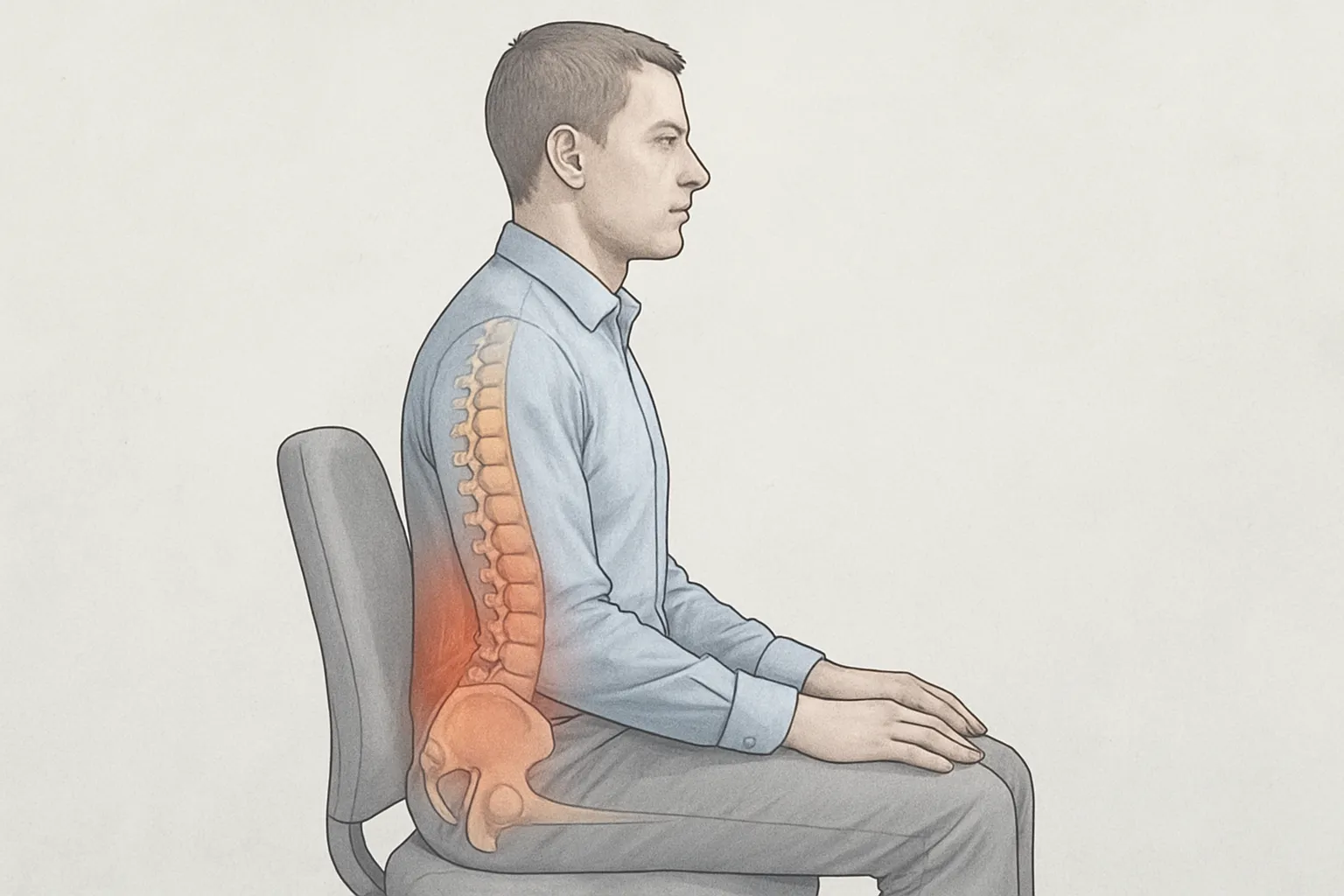
Apply a ergonomics Prudent means adjusting the environment to reduce unnecessary demands without immobilising oneself. It is useful to bring the task closer to the body, distribute the weight between both sides and alternate grips so as not to always load the same structures. When sitting, look for foot and back support with the backrest that allows you to change between comfortable positions; when working with a screen, raise the monitor to avoid prolonged bending of the neck and place the keyboard/mouse close to minimise reaching. Rather than “the perfect posture”, it is advisable to prioritise the postural variability and take frequent short breaks when a position is held for a long time.
Rest and self-regulation during the day
The rest includes both night-time sleep and micro-breaks that interrupt prolonged tasks. Basic sleep hygiene - regular sleep schedules, a dark and quiet environment, limiting stimulants late in the day and exposure to natural light in the morning - tends to promote a more predictable recovery. Throughout the day, alternating demanding activities with less demanding ones helps to pace effort; if fatigue or increased symptoms appear, slowing down or breaking up the task may be reasonable. Systematic observation of how the body responds over the next 24 hours guides prudent adjustments.
Controlled progression of everyday activities
Progression is based on small, planned increases in the time, frequency or load of a task, while maintaining a margin of tolerance. A pacing approach combines gradual steps with scheduled breaks, using simple benchmarks such as perceived exertion and response over the next few hours: if the activity leaves transient and manageable discomfort, maintaining or slightly increasing may be considered; if symptoms intensify and do not normalise with the usual rest, it is preferable to reduce, split the task or extend the adaptation time. This controlled progression seeks to reconcile participation in daily life with a measured exposure to demands.
Warning signs and prudent criteria for pausing or requesting assessment in injury prevention with conservative approach
Immediate warning signs
- Sudden severe pain which forces the activity to stop or appears with a clicking sound accompanied by loss of function.
- Visible deformity, inability to support or use of the limb, or rapid increase of swelling and bruising.
- Neurological deficitsudden loss of strength, sensation or coordination, persistent tingling or “draught” sensation.
- Pain at rest or at night that does not resolve with usual measures, associated fever or malaise.
- Signs of a possible vascular event: unilateral leg swelling with heat and pain on palpation; if it is accompanied by chest pain or shortness of breath, is a matter of urgency.
Prudent criteria for pausing activity
- Technique-impairing pain, The use of a stifle, causes lameness or obvious compensations during movement.
- Progressive worsening during the session or persistence of symptoms that do not improve after a reasonable period of relative rest.
- Noticeable loss of range of motion, prolonged stiffness after activity, or a feeling of instability, joint “failure” or joint locking.
- Point pain on bony palpation with increasing sensitivity under repetitive loads, compatible with structural overload.
- Fatigue that prevents control postural or alignment, with difficulty in maintaining the quality of the gesture.
When to ask for clinical assessment
- Following a high-energy injury mechanism or twisting with snapping and functional loss.
- If the symptoms persist or recur at the same point despite careful adjustment of load and rest.
- In the face of pain that limits basic activities of daily life or prevents conservative progression with no signs of improvement.
- In the presence of conditions that increase the risk (e.g. osteoporosis, use of corticosteroids or anticoagulants, history of overuse injuries, neuropathies), even with mild symptoms.
- If they appear RED FLAGS in the spine: impaired sphincter control, “saddle” anaesthesia or progressive weakness.